GameStop CEO Ryan Cohen Cannot Explain Where the $16 Billion Is Coming From for His eBay Bid

1AM Gamer Team
6 May 2026 08:00 AM BSTRyan Cohen wants to buy eBay for $56 billion. He just can't explain where the money is.
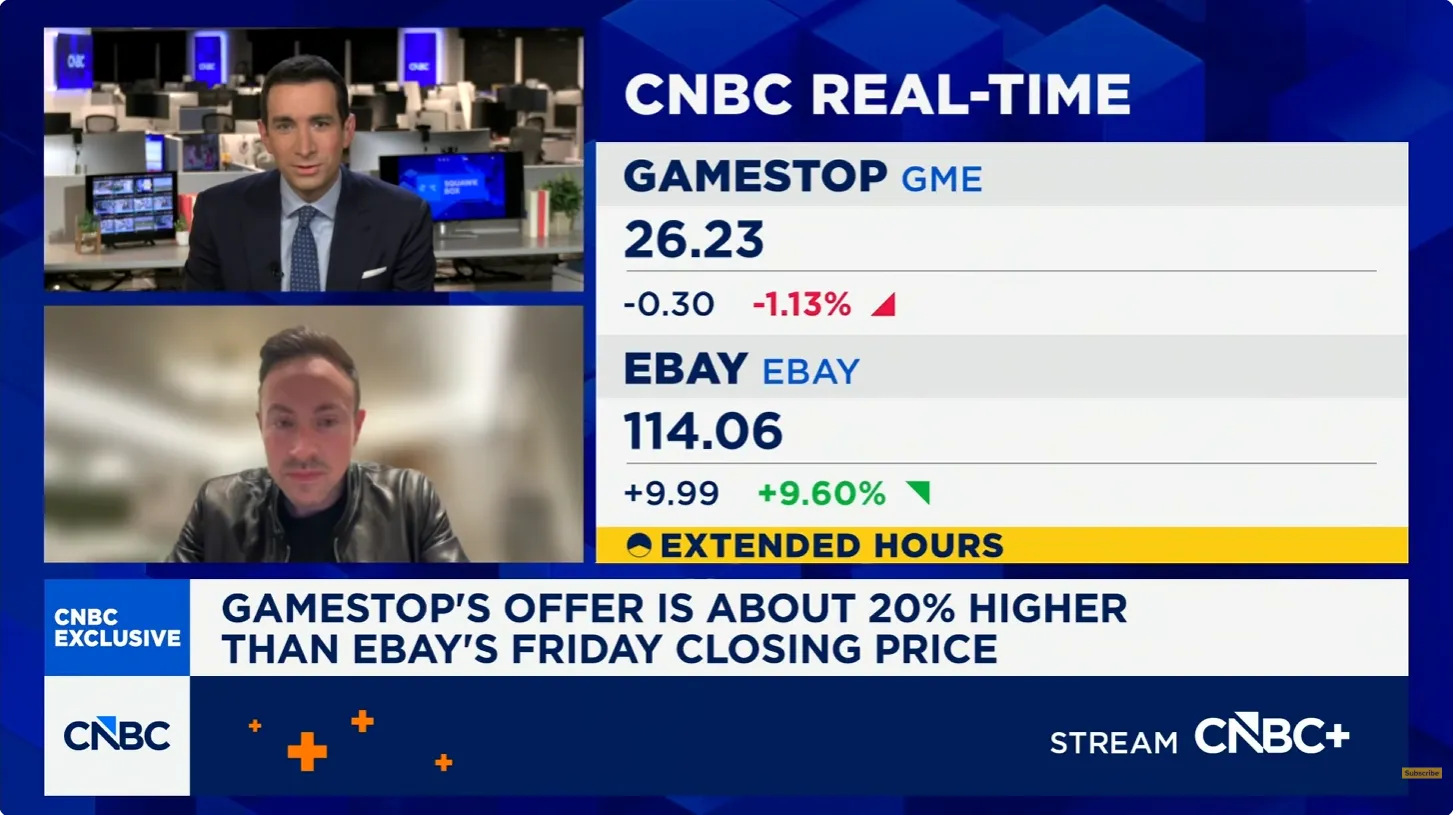
As we covered when the bid first dropped, GameStop made an unsolicited $55.5 billion offer to acquire eBay at $125 per share in a deal split evenly between cash and stock. Cohen, who owns around 9% of GameStop and would become CEO of the combined company if the deal closes, told The Wall Street Journal he wants to turn eBay into "a legit competitor to Amazon." Fine. Big ambition. But then he went on CNBC's Squawk Box, and things got strange fast.
The numbers, laid out plainly by host Andrew Ross Sorkin, tell a story Cohen seemed unwilling to engage with. GameStop has roughly $9.4 billion in cash and liquid investments on its balance sheet as of January 31 this year. There's up to $20 billion in debt financing lined up from TD Securities. Add GameStop's market cap, and you're somewhere around $40 billion. The deal is $56 billion. That's a $16 billion gap. So Sorkin asked where the rest of the money would come from.
"It's on our website. It's half cash, half stock. But the details are on our website," Cohen replied.
Sorkin broke it down again, in plain terms. Cohen's response: "We'll see what happens."
At that point, co-anchor Becky Quick stepped in. Same question. Cohen's answer: "I don't understand your question."
He said it again. Twice. "I don't understand your question." For what is, by anyone's measure, a pretty straightforward question.
What Cohen did eventually suggest is that GameStop would issue additional stock to bridge the gap, which would significantly dilute existing shareholders. When pushed on whether that actually benefits shareholders at all, his response was simply "I'm aligned with shareholders." Host Michael Santoli then asked where the evidence was that Cohen knows how to grow a mature consumer business, which prompted Cohen to fire back: "Didn't you guys call for GameStop's demise multiple times?"
Look, to be fair to Cohen, GameStop probably shouldn't still exist. The company has been called a dying bricks-and-mortar retailer for years. It burned through its credibility with crypto in August 2023, pulling out of the space and shutting its short-lived NFT marketplace just months later. At the start of 2025 it had around 2,325 U.S. locations. By the end of the year it had closed 590 of them, and then kept closing more into 2026. The company also held its first Trade Anything Day, which saw customers bringing in bobcats and geese for trade-in credit, to the frustration of store employees.
Cohen's pitch for eBay isn't total nonsense on paper. GameStop's plan involves cutting $2 billion in annual costs within a year of closing the deal, targeting eBay's bloated marketing budget, which totalled $2.4 billion in fiscal 2025 while net active buyer growth sat below 0.75%. The company projects those cuts alone would lift eBay's earnings per share from $4.26 to $7.79 in year one. GameStop also floated the idea of using its roughly 1,600 remaining U.S. stores as physical infrastructure for eBay's marketplace, covering authentication, intake, and fulfilment.
Whether eBay sees it that way is another matter. The auction platform confirmed it had no prior discussions with GameStop before receiving the proposal, but said its Board of Directors "will carefully review and consider the unsolicited proposal to determine the course of action that it believes is in the best interests of the company and all eBay shareholders." eBay shares closed about 5% higher on Monday at $109.33. GameStop dropped 10.14% to $23.84. Investors are sceptical.
The Wall Street Journal has reported that Cohen may look to Middle Eastern sovereign-wealth funds to fill the financing hole, but he didn't breathe a word of that on CNBC.
Investor Michael Burry, who earlier this year described Cohen as "milking" a crappy business while waiting for the right acquisition target, has since exited his GameStop position entirely. He had hoped Cohen would build something resembling a disciplined, modern-day Berkshire Hathaway. That vision and a leveraged $56 billion eBay bid don't obviously belong in the same sentence.
Cohen's compensation package gives him a strong personal incentive to make this work. He stands to collect up to $35 billion in stock if the combined company's market value hits $100 billion. In January he told The Wall Street Journal the deal would be "ultimately either going to be genius or totally, totally foolish."
Based on Monday's interview, we're still waiting to find out which.
Related Articles
GameStop Makes $55.5 Billion Bid to Buy eBay and Take on Amazon
GameStop has made a $55.5 billion offer to acquire eBay. CEO Ryan Cohen wants to turn the platform into a real Amazon rival using GameStop's 1,600 stores.
1AM Gamer Team
5 May 2026
eBay Rejects GameStop CEO Ryan Cohen's $56 Billion Takeover Bid as 'Neither Credible Nor Attractive'
eBay's board has rejected GameStop CEO Ryan Cohen's $56 billion takeover bid, calling the unsolicited offer neither credible nor attractive in a blunt letter.
1AM Gamer Team
13 May 2026
Amazon, Not IO Interactive, Will Publish Future 007 Bond Games
Amazon Game Studios is taking over publishing duties for future James Bond games. IO Interactive self-published First Light, but the arrangement was a one-off.
1AM Gamer Team
4 June 2026